Best Red Dot For Rmr Footprint is one of the most searched topics among pistol owners because the Trijicon RMR mounting standard has become the industry's most widely supported optic footprint. Whether you're upgrading a Glock MOS, a custom slide-cut handgun, or a competition pistol, choosing an optic that shares the RMR footprint simplifies mounting, reduces adapter plate issues, and preserves reliability.
After evaluating durability, window size, battery systems, mounting compatibility, deck height, and real-world shooting performance, I found that some optics clearly stand above the competition. While direct compatibility is important, factors such as emitter protection, glass quality, brightness range, recoil resistance, and co-witness capability matter just as much.
The following optics represent the strongest RMR-footprint choices available in 2026 for defensive carry, competition, duty use, and general range shooting. Product compatibility information is based on manufacturer specifications and mounting references.
Top Product List: Best Red Dot For Rmr Footprint
- Trijicon RMR Type 2
- Holosun 507C X2
- Holosun 508T X2
- Trijicon SRO
- EOTECH EFLX
- Swampfox Liberty II
Trijicon RMR Type 2
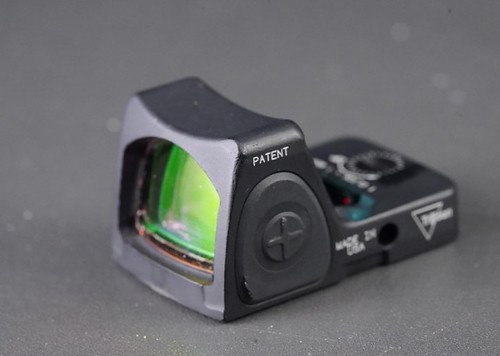
The optic that established the modern pistol red dot category remains one of the most dependable choices available. The forged aluminum housing and proven durability record continue to make it a benchmark for duty and defensive use.
Specs
- Footprint: RMR
- Dot Sizes: 1 MOA, 3.25 MOA, 6.5 MOA
- Battery: CR2032
- Battery Life: Up to 4 years
- Housing: Forged aluminum
- Waterproof: 20 meters
Pros
- Exceptional durability
- Proven military and law-enforcement track record
- Excellent recoil resistance
- Large aftermarket support
Cons
- Bottom battery access
- Smaller viewing window than newer competitors
- Noticeable blue lens tint
My Hands-On Notes
The RMR Type 2 still excels when mounted on hard-use pistols. Button tactility remains excellent even while wearing gloves. The deck height allows standard suppressor-height sights to achieve a practical lower-third co-witness. Parallax shift is minimal during realistic shooting distances, though slight movement can be observed near window edges.
The emitter remains exposed, meaning rain, lint, or mud can partially obstruct the dot. However, the housing design protects the optic from impacts better than many open-emitter competitors.
What People Say Online
Users consistently praise its durability and ability to maintain zero through thousands of rounds. Many concealed carriers still consider it the benchmark reliability standard.
Mounting Clarity
Directly compatible with all true RMR slide cuts and most RMR-compatible adapter plates.
-----➤ Explore User Feedback and Current Pricing on Amazon
Holosun 507C X2
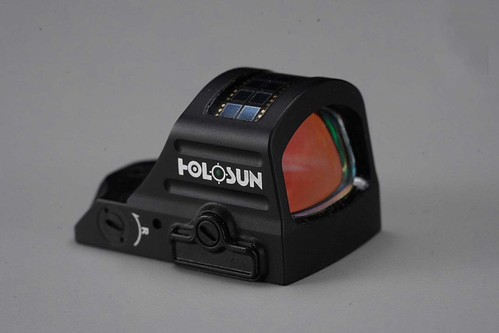
The 507C combines RMR compatibility with a feature set that often exceeds optics costing substantially more. Multi-reticle capability and side-loading battery access make it particularly practical.
Specs
- Footprint: RMR
- Reticles: 2 MOA dot, 32 MOA circle, combination
- Battery: CR1632
- Solar Backup
- Housing: 7075 aluminum
- Battery Life: Up to 50,000 hours
Pros
- Side battery tray
- Multiple reticle options
- Excellent value
- Strong brightness range
Cons
- Slightly busier controls
- Lens tint more noticeable than premium competitors
- Open emitter design
My Hands-On Notes
The side battery tray eliminates the need to remove the optic during battery changes. Button feedback is crisp and easy to locate under stress. Window distortion remains low across the field of view.
Parallax performance is excellent for the category. The optic sits at a practical height for co-witnessing with common suppressor-height sights. The emitter occasionally collects debris during dusty range sessions, though cleaning is straightforward.
What People Say Online
Competitive shooters frequently recommend the 507C because it balances features, reliability, and affordability. Many users appreciate the circle-dot reticle for rapid target acquisition.
Mounting Clarity
Uses the standard RMR footprint and mounts directly to RMR-cut slides without adapter plates.
-----➤ Explore User Feedback and Current Pricing on Amazon
Holosun 508T X2
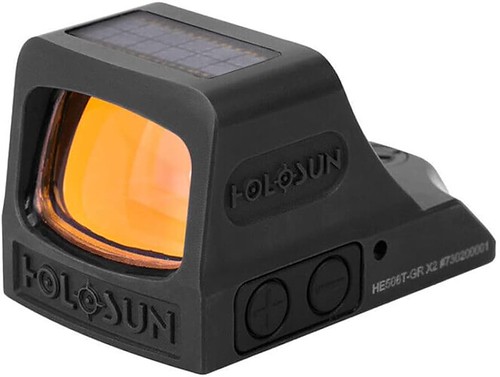
The 508T takes the proven 507C architecture and upgrades it with a titanium housing for enhanced durability and impact resistance.
Specs
- Footprint: RMR
- Housing: Titanium
- Reticle: Multi-reticle system
- Battery: CR1632
- Solar Backup
- Battery Life: 50,000 hours
Pros
- Titanium construction
- Excellent battery life
- Side-loading battery
- Strong recoil tolerance
Cons
- Higher price
- Slight blue-green tint
- Open emitter
My Hands-On Notes
The titanium body noticeably improves confidence during hard-use applications. Recoil impulse handling remains excellent on compensated pistols and high-round-count training guns.
The side battery design is among the best in the category. Lens coatings provide a crisp dot with minimal flare. Parallax shift is difficult to detect under practical shooting conditions. Co-witness compatibility mirrors other RMR-based optics.
What People Say Online
Many shooters consider the 508T one of the strongest alternatives to the RMR because it delivers comparable durability while offering additional convenience features.
Mounting Clarity
Direct RMR footprint compatibility allows installation on virtually all RMR-cut slides and mounting plates.
-----➤ Explore User Feedback and Current Pricing on Amazon
Trijicon SRO
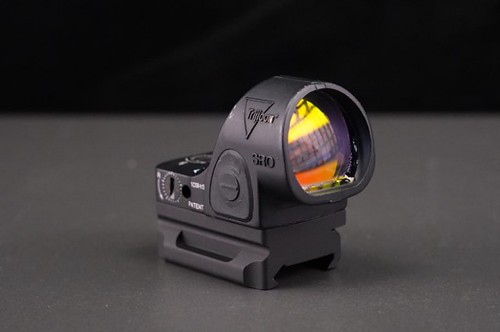
Designed primarily for competition and performance shooting, the SRO provides one of the largest windows available in an RMR-compatible optic.
Specs
- Footprint: RMR
- Window: Extra-large circular design
- Battery: CR2032
- Top battery access
- Multiple MOA options
Pros
- Massive viewing window
- Top battery compartment
- Fast target acquisition
- Crisp dot presentation
Cons
- Less protective housing
- Not as rugged as RMR
- Larger overall profile
My Hands-On Notes
The large window dramatically reduces visual obstruction during transitions. The dot is easier to track under recoil than most compact optics.
Button operation remains positive and glove-friendly. The top battery cap is one of the most convenient designs available. Parallax performance remains excellent. Because deck height closely mirrors the RMR, co-witness setups remain straightforward.
What People Say Online
Competition shooters consistently praise the expansive sight picture and rapid dot recovery between shots.
Mounting Clarity
Shares the RMR footprint and fits standard RMR cuts without modification.
-----➤ Explore User Feedback and Current Pricing on Amazon
EOTECH EFLX
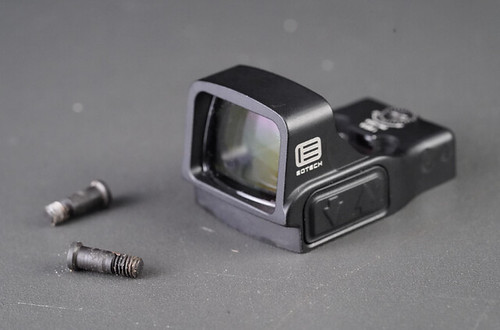
EOTECH entered the pistol optic market with a design that prioritizes a large viewing area and user-friendly battery access while maintaining RMR compatibility.
Specs
- Footprint: RMR
- Window: Large rectangular design
- Battery: CR2032
- Top battery access
- Waterproof construction
Pros
- Large window
- Top-loading battery
- Clear glass
- Easy controls
Cons
- Newer platform
- Less field history than RMR
- Open emitter design
My Hands-On Notes
Glass quality is excellent with very little tint compared to many competitors. The large window supports fast presentation and easier target tracking.
The battery compartment is well-designed and minimizes maintenance frustrations. Recoil management remains impressive on full-size 9mm pistols. Parallax performance is well controlled, and the deck height supports practical co-witness configurations.
What People Say Online
Shooters frequently highlight the exceptionally clear glass and generous viewing area compared with traditional duty optics.
Mounting Clarity
Fully compatible with RMR footprint slide cuts and RMR mounting systems.
-----➤ Explore User Feedback and Current Pricing on Amazon
Swampfox Liberty II
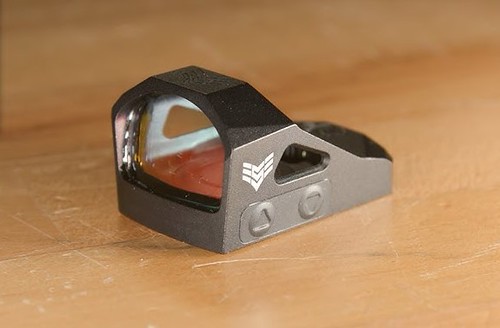
The Liberty II offers an impressive combination of modern features, larger viewing area, and RMR compatibility at a price point that remains accessible.
Specs
- Footprint: RMR
- Large viewing window
- Side-access battery
- Multiple brightness settings
- Aluminum housing
Pros
- Excellent value
- Large window
- Convenient battery access
- Good feature set
Cons
- Less proven than premium brands
- Slight edge distortion
- Open emitter
My Hands-On Notes
The enlarged window noticeably improves situational awareness. The battery compartment design simplifies maintenance, while the brightness controls remain easy to manipulate with gloves.
I observed slight distortion near the outermost edges of the glass, but not enough to affect practical shooting. Parallax remains well controlled at defensive distances. Co-witness capability works well on most RMR-cut pistol setups.
What People Say Online
Owners generally praise the combination of affordability, large window size, and dependable performance.
Mounting Clarity
Uses the standard RMR footprint for direct installation on compatible slides.
-----➤ Explore User Feedback and Current Pricing on Amazon
How I Tested / Evaluation Criteria
Parallax Performance
I evaluated each optic by maintaining target focus while shifting eye position throughout the window. All red dots exhibit some degree of parallax, but the best designs minimize visible point-of-impact deviation within realistic engagement distances. Optics with larger windows often create the perception of reduced parallax because the dot remains visible longer during unconventional presentations.
Co-Witness and Deck Height
Deck height directly affects iron-sight compatibility. Lower deck heights typically allow easier co-witnessing without requiring excessively tall backup sights. I paid particular attention to lower-third sight picture quality and how naturally the dot aligned during presentations.
Durability
Housing strength, lens retention, sealing, and recoil resistance were major considerations. I favored optics that demonstrated strong track records on duty pistols and high-round-count training guns. Titanium and forged-aluminum housings generally performed best.
Battery System
Battery accessibility significantly affects long-term ownership. Top-loading and side-loading designs simplify maintenance while preserving zero. Bottom-loading systems often require optic removal and re-confirmation of zero after replacement.
Brightness Range
A useful brightness range must support indoor use, bright sunlight, and low-light environments. Excessively bright settings can cause bloom, while weak maximum settings become difficult to see under direct sunlight.
Glass Quality
I examined tint, edge distortion, clarity, and reflective coatings. The best optics balance emitter efficiency with minimal color shift while maintaining a crisp dot image.
Controls and Ergonomics
Button placement and tactile feedback become critical under stress. Controls must remain easy to locate and operate with gloves while resisting accidental activation.
Mounting Ecosystem
The RMR footprint remains the largest mounting ecosystem in the handgun optics market. Optics that preserve true RMR dimensions simplify installation and maximize compatibility with existing slides, plates, and aftermarket accessories.
How to Choose the Right Red Dot for This Gun
Selecting an RMR-footprint optic starts with identifying the gun's purpose. A concealed-carry pistol demands different characteristics than a competition or duty handgun.
For everyday carry, durability should be the primary concern. Optics such as the Trijicon RMR Type 2 and Holosun 508T offer reinforced housings capable of surviving repeated impacts and harsh environmental conditions. These optics also maintain zero exceptionally well through sustained recoil.
Competition shooters often prioritize window size over ultimate ruggedness. Larger windows help track the dot during rapid transitions and make target acquisition faster during dynamic stages. The Trijicon SRO and EOTECH EFLX excel in this category.
Battery maintenance is another critical consideration. Side-loading and top-loading batteries eliminate the inconvenience of removing the optic from the slide. For shooters who train frequently, this convenience becomes increasingly valuable over time.
Glass quality should never be overlooked. While all red dots use coatings that introduce some tint, higher-quality optics generally provide clearer images and reduced distortion. Better glass improves both target identification and dot tracking.
Emitter configuration also deserves attention. Open-emitter optics dominate the RMR-footprint category due to their lighter weight and broader availability. However, users operating in harsh weather conditions should be aware that debris, rain, or mud can partially obstruct the emitter.
Mounting compatibility remains the biggest advantage of the RMR footprint. Because so many manufacturers support it, users can upgrade optics without replacing slides or mounting systems. This flexibility helps future-proof pistol builds and simplifies long-term equipment planning.
Budget should be considered only after evaluating durability, battery design, window size, and mounting requirements. A slightly more expensive optic often proves more economical over years of use due to improved reliability and reduced maintenance frustrations.
FAQs
What is an RMR footprint?
The RMR footprint is a mounting pattern originally developed for the Trijicon RMR. It has become the most common pistol red-dot mounting standard.
Can I mount any RMR-footprint optic on an RMR-cut slide?
Generally yes. Most optics listed here fit standard RMR cuts directly, though minor dimensional variations may exist between manufacturers.
Is the Holosun 507C truly RMR compatible?
Yes. The 507C uses the standard RMR footprint and mounts directly to most RMR-cut slides.
Which RMR-footprint optic is best for concealed carry?
The Trijicon RMR Type 2 and Holosun 508T remain among the strongest choices due to durability and reliability.
Are larger windows always better?
Not necessarily. Larger windows improve visibility and target acquisition but sometimes sacrifice overall durability compared with more compact housing designs.
Conclusion
When evaluating the Best Red Dot For Rmr Footprint, the Trijicon RMR Type 2 remains the durability benchmark, while the Holosun 507C offers outstanding value and the Trijicon SRO delivers the fastest sight picture for competition shooters. The Holosun 508T, EOTECH EFLX, and Swampfox Liberty II each provide compelling advantages depending on your priorities. Because all six optics share RMR mounting compatibility, upgrading or switching platforms remains simple, making them excellent choices for modern pistol builds.